
Cape First
Manifesto
The principles that guide how we show up for one another.
We are the people of the Cape, shaped by a shared territory, a common history, and a rich inheritance drawn from indigenous, settler, slave, migrant, and civic traditions. Our identity is rooted in localism, community, language, culture, and the belief that us with deep historic ties to the Cape should have a primary say in their own future.
Cape First: A Manifesto for Self-Determination
We are the Cape First movement.
We, the proud peoples of the Cape, have our own unique character and culture derived from a common history, language and above all, a common territory we call home.
Under the colonial, Apartheid and current African nationalist regimes, we have been subjected to severe injustices and discrimination. The racial marginalisation in our towns, the demographic replacement of our cities, and the large-scale illegal occupation of our land, among other injustices.
The continuous attack on our history, livelihoods and our future must be thwarted by putting the Cape first, by all means necessary, so as to ensure that we can provide a future for generations to come.
Who are the Kapenaars?
Our people hold a rich and diverse heritage, with influences from across the globe, yet unique to the Southern Tip of Africa. Our heritage emerged from indigenous, slave and settler ancestry, and has been enriched by those who have migrated to the Cape, contributed to its development and committed loyalty to its communities, from across Europe, Asia and Africa.
Our earliest ancestors were the Khoi and the San, having called this place home for tens of thousands of years. They consisted of a variety of clans and tribes, traversing the land as nomads, semi nomadic hunter gathers, pastoralists and fishermen on the coast. An egalitarian people, these clans consisted of small, mobile groups typically composed of extended families. Where more formal political arrangements existed, leaders still found their power greatly curtailed by the need to appeal to their followers for political support.
As European colonialism expanded across the world, these first nations communities found themselves coming into more frequent contact with Europeans. These interactions were both peaceful and violent at times, such as the 1510 Battle of Salt River, where the Goringhaiqua clan defeated a Portuguese expedition, earning the Cape’s first nations a fearsome reputation amongst the Europeans.
Nonetheless, pressure for a permanent refreshment station at the Cape for ships travelling from Europe to the East grew and in 1652 , the Dutch East India Company (VOC) established a permanent settlement in Table Bay. This marked the beginning of 370 years of permanent European presence in the Cape.
As this refreshment station transformed into a colony, the need for labour grew, resulting in the importation of slaves from present-day Angola, Guinea, Mozambique, Madagascar, Southeast Asia, and the Indonesian archipelago, who by the 18th century outnumbered the local European settler population.
These different groups interacted with one another over the centuries, resulting in the development of new endemic communities and, with it, the need for a common mode of communication, resulting in the establishment of the Afrikaans language. Developing out of Cape Dutch, it borrowed vocabulary from Malay, Portuguese and indigenous languages, with one of the earliest Afrikaans texts being written in the 19th century in Arabic script by Abu Bakr Effendi, an Ottoman religious scholar sent to the Cape.
British settlement in the Cape began in the 19th century, following the British conquest of the colony in 1806, reinforced by thousands of settlers on the colony’s eastern frontier in 1820. They brought with them a political revolution in the territory, overseeing the abolition of slavery, the introduction of English common law, and greater rights for first nations people and freed slaves. The Cape also underwent an economic modernisation that coincided with its political evolution, developing responsible government in 1872, elected under a non-racial, property-based franchise system known as the Cape Qualified Franchise.
Developments elsewhere in Southern Africa also had a significant impact on the trajectory of the Cape.
Genocidal conflicts termed the Mfecane saw thousands of refugees move southwards into what is today the Eastern and Western Cape. Many of these groups came to be known as the amaMfengu, later integrating into the broader Xhosa identity, while also being incorporated into the Cape Colony under British rule. Over time, their descendants have become part of the Cape’s wider social fabric, alongside communities with far longer historical roots in the region.
In the face of many challenges under colonial jurisdiction and seeking greater independence for themselves, the descendants of Dutch colonialists saw greater freedom for themselves in the African interior, becoming termed trekboers. They established political systems that were decentralised, informal, and shaped by frontier conditions, relying on local officials such as veldkornets and heemraden to handle basic administration, justice, and defence. This political culture later influenced the more formal republican systems of the Boer republics established by the later Voortrekkers.
Another group emerging out of the Cape seeking greater independence for themselves, a semi-nomadic, Afrikaans-speaking nation of mixed ancestry. They established their own states, which combined elements of traditional Khoisan systems with some cultural elements adopted through contact with the early Trekboers. The Griqua organised themselves under hereditary leaders known as captains, supported by councils that assisted in lawmaking, dispute resolution, and diplomacy. Their political system was more structured than many of their neighbours, with the Griqua developing written constitutions and legal codes, influenced by missionary Christianity and Dutch legal traditions.
This diverse ecosystem of political systems was not to last, however. As the British Empire expanded further into the interior, one by one, they ended the independence of each of these states, most notably the Orange Free State and the South African Republic at the end of the Second Boer War. These territories, together with the Cape, were consolidated into a centralised unitary state, the Union of South Africa, in 1910. This occurred despite the efforts of groups within the Cape, such as the multiracial “Schreiner Delegation” led by former Cape Prime Minister William Schreiner, which travelled to London to plead for Britain to protect its non-racial franchise and to guard against excessive centralisation - requests that were largely ignored.
For centuries, political authority in the Cape has been rooted in localism, consent, and civic participation. Our ancestry combines indigenous, global, settler, and migratory influences, shaping a civic culture unique to the Southern Tip of Africa. These trends have made the Cape’s institutions and identity fundamentally different from the rest of South Africa. The Cape is different. The Cape is ours.
How is the Cape under threat?
Underpinning the challenges threatening the Cape in the 21st century is its relationship with South Africa. Pretoria appropriates the language of nationhood to justify its actions. While they claim to stand for a “South African nation”, the truth is that such a nation does not exist. Rather, South Africa consists of multiple nations with distinct and rich cultures, histories, values, civilisational inheritances and political outlooks.
While the South African Constitution talks of “unity in diversity”, they have scrubbed “in diversity” out of the equation and replaced it with “at all costs”. Rather than respecting the Cape’s uniqueness, the Cape’s majority is forced to submit to the countrywide South African majority. This is not reconciliation. It is colonisation.
Under the guise of “redress,” over 140 race-based laws regulate almost every aspect of economic life, education, employment, and business ownership. The tiniest details of daily activity are filtered through racial classification. When national demographics are automatically and mechanically enforced on the Western Cape, the result is disproportionate, punitive, and designed to punish the Cape’s unique reality. As Constitutional Court Justice Robert Nugent starkly observed in highlighting the inequity: “in the Western Cape, nine out of every 100 opportunities are made accessible to some 2.8 million Coloured people, while 1.9 million Black African people have access to 73”.
The assault doesn’t end at economics. It invades our unique language and culture, too. In the name of “anti-colonialism,” Afrikaans is being pushed out of schools, universities, and public life. Cultural heritage is treated as something to dilute, apologise for, or erase entirely. Increasingly, some of our oldest towns, built by us, are the subjects of political renamings. Our history and culture are under direct attack.
These policies have not only marginalised the Cape’s legacy communities - they have deliberately brought about their demographic replacement.
In barely one generation, African nationalist policies of dispersal have flooded the Cape with millions from the north. Failed provinces, such as the Eastern Cape, have triggered a mass exodus westward. Every town and city in the Western Cape bears the scars of the land invasion crisis. Railway lines are taken over. Ancient forests are cut down. Housing projects occupied. Rather than fighting back against central government legislation such as the PIE Act - which drags evictions out for years while invaders multiply - the Cape’s leaders have chosen cowardly appeasement, hoping the newcomers will keep voting them into power. With the army of welfare dependents now growing far faster than the productive population, taxes and rates keep rising, working and middle-class Capetonians are priced out of their own homes, and their hard-earned wealth is slowly liquidated to sustain the new arrivals.
South Africa’s open borders have supercharged illegal immigration from across the continent, much of it intertwined with criminal syndicates, drug networks, and gang expansion. The Cape pays the full price in skyrocketing crime, overburdened hospitals and schools, congested roads, collapsing services, and eroded social cohesion.
We welcome builders, those who come to settle here legally, migrate here legally, integrate fully into Cape life, work hard to improve their own lives, and uplift the lives of their fellow Kapenaars. We open our doors wide to patriots of any background who respect our laws, contribute productively, and commit to building a better future together in this shared home.
We must rewrite eviction laws so that illegal occupiers of land or infrastructure are removed within days, not years. We must deport every single illegal immigrant without exception. We must expel foreign criminals who violate our laws. We must halt this invasion.
Finally, in addressing these challenges facing us from the outside, we must also address those challenges which threaten to tear us apart from the inside. Central to that is the question of the land.
This shared territory holds the roots of all our peoples’ stories, yet it is also the source of some of our deepest tensions. Over centuries, land ownership has shifted sometimes by agreement and purchase, other times by conquest, dispossession, or force.
Where there are valid, verifiable and recent claims of dispossession, there must be redress through state-facilitated restitution or fair compensation. Justice cannot be ignored. But neither can stability.
Private property rights must be protected absolutely in the present. This is to ensure confidence, both from our own people and the world, that our society is one that can be securely invested in. A society that cannot guarantee ownership is a society that slowly collapses into dependency and decay.
Above all, our primary focus must be the future. We believe in genuine competition - not cronyism or rent-seeking - but productive ownership. A healthy society is one where ordinary people can acquire property, build equity and pass it on to their children. That means transforming backyard living into structured, serviced communities. Over time, pathways to ownership must be built in so that residents are not permanent tenants of the state but stakeholders in the Cape’s prosperity.
The same principle applies to farming. Where individuals want to farm, there must be pathways into the sector. By combining underutilised farmland in the Cape with training, mentorship and staged ownership for aspiring farmers, we can introduce productive new farmers into the economy - strengthening food security and expanding opportunities.
Finally, we must guard against distortions in our property market. Foreign capital and speculative investment, left unchecked, can price ordinary Cape families out of their own communities. A responsible Cape First policy must ensure that property markets serve Cape families first, not absentee speculators.
Self-determination is the solution.
Our history is clear.
When decisions were made close to home, the Cape prospered. When power was concentrated far away, we suffered. The only people who truly understand what the Cape needs are the people who live here - not politicians in Pretoria chasing the votes of people in faraway provinces.
The African Charter on Human and Peoples’ Rights, signed by South Africa itself, states: “All peoples shall have the unquestionable and inalienable right to self-determination. They shall freely determine their political status and shall pursue their economic and social development according to the policy they have freely chosen.”
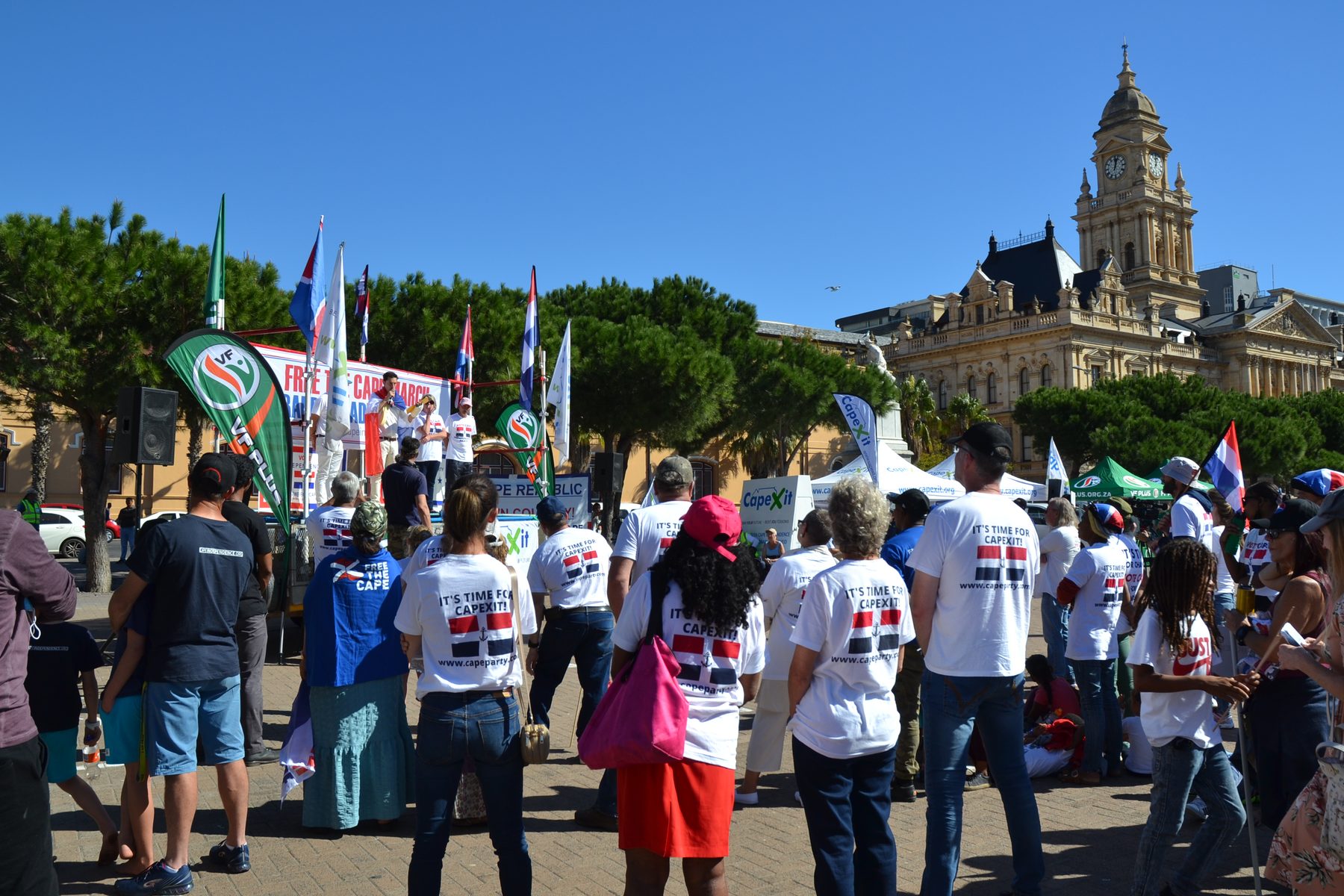
We are a people. We are a territory. We are a community with a shared history and a shared future. And we have the right to determine our own course.
Where the Constitution grants power to the province or a municipality, we must use it fully.
Where power is ambiguous, we must test it.
Where power is denied, we must challenge it.
And where the national government has failed, we have a duty to intervene.
When large parts of our province resemble war zones, with children caught in gang crossfire and murder conviction rates are disgracefully low, continuing with a business-as-usual policy for another 30 years is not good enough. We must take full control of policing in the Cape. We must establish provincial forensic units, intelligence capacity, community patrol integration and provincial private prosecution teams. Order must be restored to our streets.
Our economy generates nearly 17% of national tax revenue, yet we receive back only a fraction. Billions flow out every year to subsidise collapse elsewhere while our rates rise, electricity tariffs climb, and fuel costs grow. Young people struggle to find work, while salaries stretch thinner every month. We must seize control of our taxes in the Cape. We must challenge the Division of Revenue Act and must pursue fiscal federalism aggressively and unapologetically. Our taxes must serve our people.
The Cape’s waters hold the overwhelming share of South Africa’s marine wealth, yet our traditional fishing communities have been marginalised, with stocks depleted and our fishermen hamstrung by licensing complications. We must end the plundering of our coastline by foreign vessels and restore pride and confidence to our traditional industries.
Our schools are in decline, producing tens of thousands of students a year who are simply unemployable in many contexts. We have lowered expectations instead of raising performance, diluted pass marks and purged Afrikaans-medium institutions. In the Cape, we must raise the standards of education, defend mother-tongue education, support private and community model schools where they work and remove incompetence where it fails. We must aim for first-class education, not education that leaves us endlessly at the back of the class.
In addition to the collective right of the Cape people to self-determination, we also recognise that to achieve real “unity in diversity” means recognising the right to self-determination of the Cape’s constituent communities as well. Autonomy starts at the individual and then flows upward, to their community, nation and the wider cultural ecosystem they inhabit. Following in the spirit of decentralisation that has often characterised the political history of the Cape, our communities should be encouraged to take responsibility for their schools, their safety, their charities, and their culture. They should be free to build spaces where their culture, identity and heritage are not only protected, but have the ability to continue to expand. The role of the state in the Cape should be to empower these efforts, not demonise them.
In pursuing self-determination, Section 235 of the Constitution already provides a clear and powerful mechanism for beginning the process of restructuring our political system within the existing constitutional order. Aggressively asserting this constitutional provision is essential to moving beyond mere rhetoric and securing the fiscal and political autonomy necessary for the Cape and our communities to govern ourselves.
A Cape to be proud of. A home worth defending.
We believe that by putting the Cape first, we can reverse our decline. It will not be easy. It will require courage. It will require discipline. It will require confrontation. But the alternative is unthinkable and unacceptable.
Another Cape is possible. A Cape where women and children can walk the streets safely at night. Where hard work is rewarded with opportunity. Where young people can find jobs without being forced to emigrate. Where property ownership is attainable. Where our green spaces are protected and expanded. Where our native language is secure. Where our communities feel that they have an equal stake in the political system. Where our government answers to our people.
We want to build a Cape that is confident. A Cape that is prosperous. A Cape that governs itself in its own interests. Only.
It will only be delivered if we decide - collectively and unapologetically - to put the Cape First. Always.